The Framework at a Glance
Define the Problem Space and constraints.
Move the Scanner and protect the Invariant.
Record evidence and justify the answer.

The Knowledge Gap the CCF Solves
Many developers can build applications but still struggle when an unfamiliar algorithm asks them to reason from first principles.
The gap is not intelligence or effort. It is training: most learners are shown patterns before they are taught how constraints, movement, state, and proof shape the solution.
The CCF closes that gap by teaching the reasoning sequence behind correct code.
Traditional DSA Creates Pattern Dependency
- Two Pointers
- Sliding Window
- Fast & Slow Pointer
- Monotonic Stack
- Prefix Sum
- Backtracking
- Dynamic Programming
- BFS / DFS
- Union Find
- Trie Problems
- Heap Problems
Pattern lists help after you understand the structure. They do not replace reasoning.
The Core Philosophy of the CCF
The Correct Code Framework treats algorithms as systems of:
- Movement
- State Management
- Constraint Handling
- Information Flow
- Decision Orchestration
Instead of asking which trick to remember, the learner identifies the forces acting on the problem.
CCF Structural Questions
- Is information static or changing?
- Is traversal linear, branching, cyclical, or hierarchical?
- Is state local or global?
- Is memory being preserved, discarded, compressed, or expanded?
- Are decisions reversible or irreversible?
- Is the system optimizing for speed, ordering, certainty, or minimal cost?
- Is the problem fundamentally about search, synchronization, transformation, or navigation?
From Pattern Memorization to Decision Architecture
Instead of asking "What pattern is this?" the learner asks: "What conditions force certain decisions?"
That question turns a memorized pattern into a reasoned decision.
- Graph problems become traversal-governance problems.
- Dynamic Programming becomes state preservation under overlapping computation.
- Sliding Window becomes controlled boundary movement under constraint maintenance.
- Binary Search becomes ordered elimination through certainty reduction.
- BFS and DFS become alternate traversal contracts with different guarantees.
- Hash maps become constant-time relationship indexing.
- Recursion becomes deferred state management through stack delegation.
Algorithms become variations of movement, state, constraints, evidence, and proof.
From Framework to Practice
The Framework teaches the reasoning sequence. Case Files let you practice it. The Correct Code Press Digital Library gives you the full training path.
Members train with Case Files, Reasoning Guides, the CCF Solution Builder / Simulator, field tools, proof templates, and domain pipelines for CCF Pro.
Traditional Data Structures & Algorithms vs the CCF
Traditional DSA
- Heavy pattern memorization
- Requires solving hundreds or thousands of problems
- Recognition-based learning
- Interview-focused recall
- Confidence tied to familiarity
- Skills decay without constant repetition
- Large cognitive overload
Correct Code Framework
- Structured decision-making
- Focus on reasoning and system behavior
- Transferable mental models
- Reduced dependency on memorization
- Smaller set of universal concepts
- Structural understanding over pattern recall
- Durable confidence through comprehension
Why CCF Builds Confidence
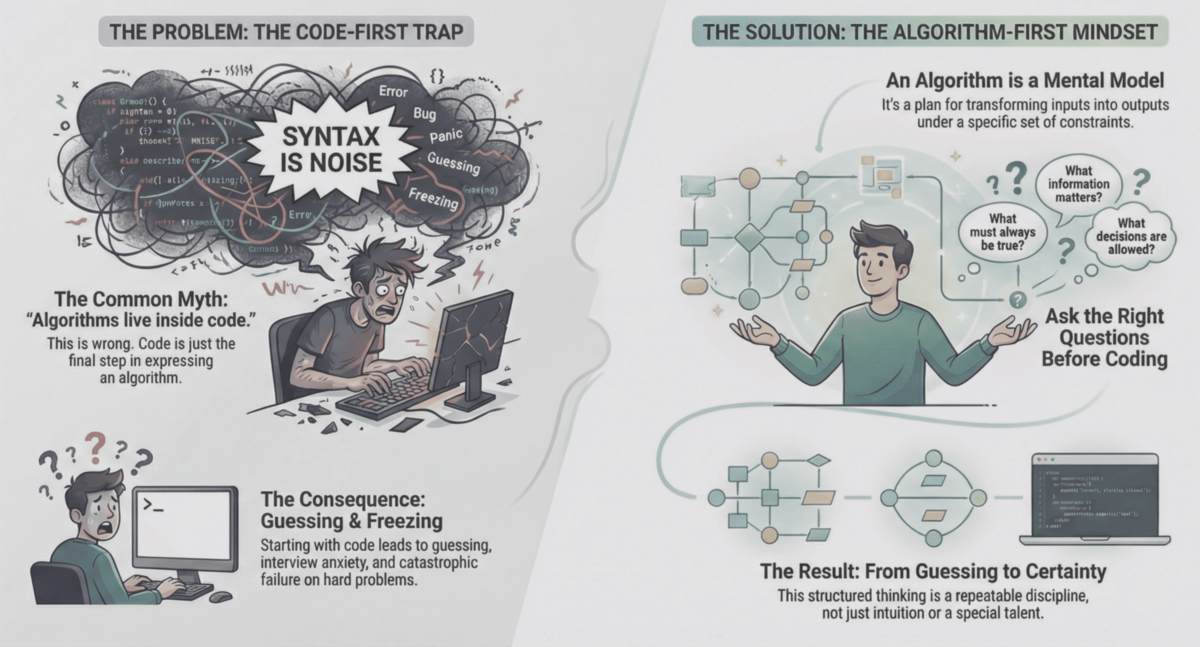
Developers often feel capable in application work but uncertain in unfamiliar algorithm problems. The CCF makes the hidden reasoning visible: define the forces, control movement, preserve the invariant, and prove the result.
Procedural vs Structural Learning
- Procedural: "Use this technique here."
- Structural: "Understand the forces acting on the problem."
- CCF: "Explain why this decision is lawful before code."
Confidence becomes durable when the learner can explain the decision path.
What the CCF Trains You to Notice
The CCF reduces unfamiliar problems into reusable reasoning moves: traversal, indexing, state retention, partitioning, synchronization, optimization, and dependency management.
The practical goal is simple: trace relationships, constraints, evidence, and proof before relying on recall.