What You'll Learn
Replace Recognition With Reasoning
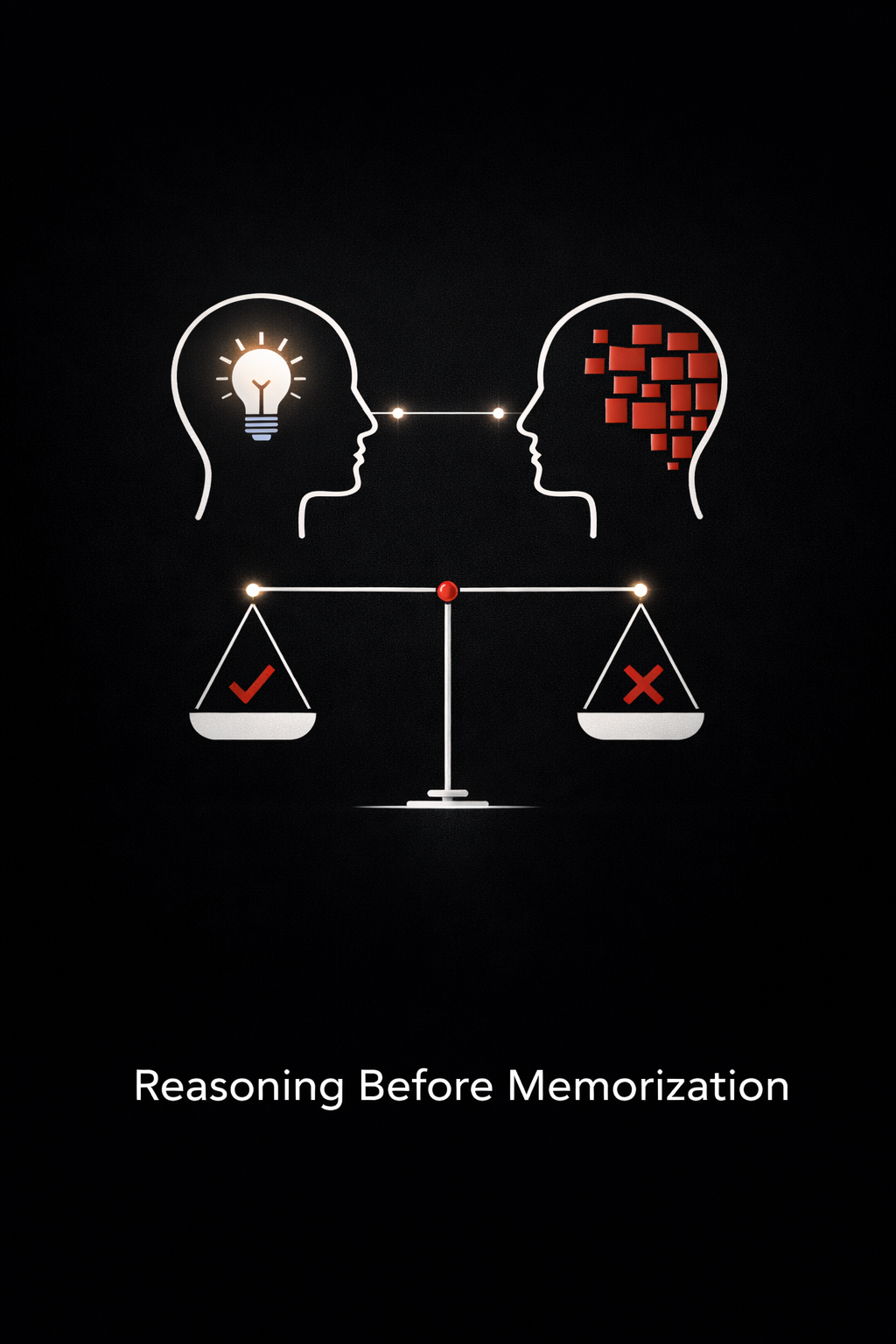
Pattern-first learning produces speed inside a familiar corridor. Book One builds the discipline that survives outside it: constraints, invariants, and steps you can explain.
Why Patterns Fail Under Pressure
Patterns work because the world repeats — until it doesn’t. Pressure removes the familiar cues memorization depends on.
Reasoning Is Not Thinking
Thinking can be free-floating. Reasoning is movement under constraints, with every step justified.
Correctness Is Not Confidence
Confidence is a feeling. Correctness is a guarantee. Only a guarantee survives unfamiliar inputs.
Explanation Is the Test
If you cannot explain why a step is safe, it is not safe. Explanation is verification, not decoration.
From Intuition to Invariants
Intuition points at plausible shapes. Invariants certify a step as safe and forbid the rest.
Constraints Create Meaning
A problem without constraints is a wish. Constraints turn 'what should I try?' into 'what is allowed?'
Decisions Without Regret
A decision is irreversible elimination under the authority of an invariant — not a guess.
Slowing Down Is a Skill
Speed comes from removing rework, and rework comes from premature movement.
Calm Is Constructed
Calm is what remains when every important question has already been answered.
Bound to Explanation
The book’s goal is to bind you to constraints, invariants, and explanation — not to make you memorize more.
Table of Contents
Twelve Chapters, Four Movements
From the comfort of memorization to a reasoning system you can defend — and the practice that makes calm a method, not a personality trait.
From the Book
How the Method Reads
The Comfortable Loop
A question appears. Your mind reaches backward. A familiar pattern surfaces. The loop is comforting: recognize, retrieve, repeat. In that loop, uncertainty disappears — and so does correctness, because nothing new was ever required of you.
Explanation Is Verification
If you cannot explain why a step is safe, it is not safe. A correct solution can be explained without reference to luck, intuition, or personal style — only by constraints, preserved truth, and lawful movement.
See the Framework
Start With the Videos
What Is the Correct Code Framework?
Why CCF starts with intent, structure, and proof before code.
Watch on the video libraryCorrect Code Philosophy
The reasoning-first philosophy behind the framework.
Watch on the video libraryCase Files Introduction
How case files turn practice into structured investigation.
Watch on the video librarySome videos require membership access. Visit the video library to see what's unlocked for your plan.
Who It's For
Book One is for developers tired of pattern roulette
Where It Fits
Book Zero Is the Required Foundation
Unlock the Full Book Library
Reasoning Before Memorization is included with Student Access, which also unlocks Book Zero and every current algorithm book from Correct Code Press.